
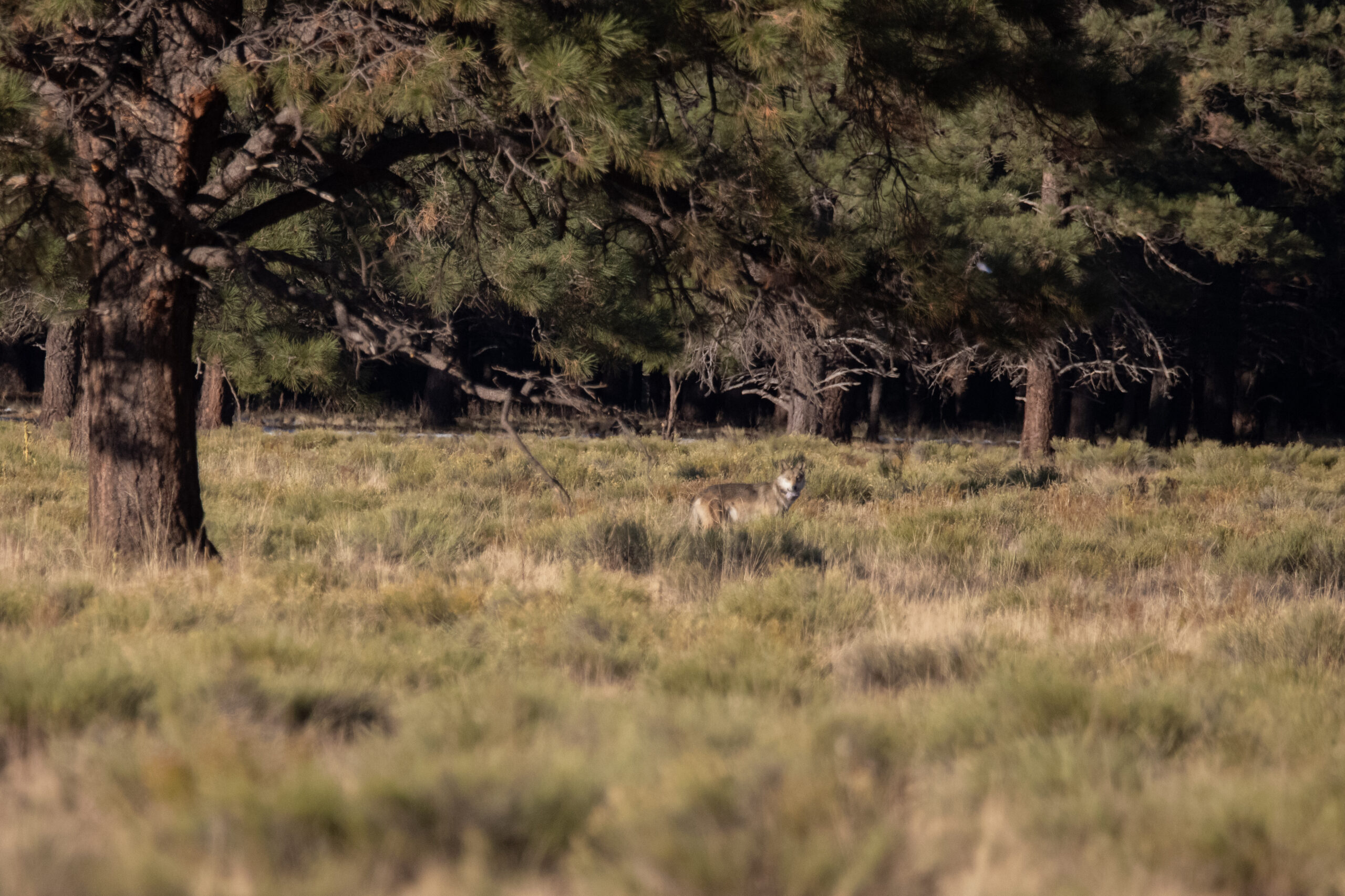
About the Lobos
Mexican Wolf Recovery
The most endangered subspecies of wolf in the world, returning to the Western United States.
286
Wolves in the wild (2024–2025)
7
Reproductive founders of the entire wild population
380+
Lobos in captive breeding facilities
Meet the Mexican gray wolf
The Mexican gray wolf (Canis lupus baileyi) is the smallest and most genetically distinct subspecies of gray wolf in North America. Adults are about 4.5 to 5.5 feet long from snout to tail, weigh 50 to 80 pounds, and have fur mixing buff, gray, red, and black. Wolves communicate via body language, scent marking, and vocalizations. Their main prey is elk, making up around 74 percent of their diet, but they also take deer, javelina, rabbits, and smaller mammals.
A near-extinction, and a return
Once widespread in the United States Southwest and Mexico, the Mexican wolf was nearly exterminated by predator control programs. By the 1970s, virtually none remained in the wild. In 1976, the lobo was listed under the Endangered Species Act, and in 1982 a recovery goal was set: at least 100 wild wolves across 5,000 square miles of historical habitat.
In 1998, captive-bred wolves were reintroduced into southeastern Arizona (Apache National Forest) and western New Mexico (Blue Range area). That same year, the first Mexican wolf pup was born in the wild in over 50 years.
Ongoing threats
Poaching has been the leading cause of death in reintroduced wolves. Policy revisions in 2015 allowed wolves to roam beyond limited boundaries, but still imposed political limits, such as Interstate 40. Wolves cannot yet establish territories in areas like the Grand Canyon. Human-wolf conflict, and the concentration of wolves into small zones, remain ongoing challenges.
A two-track recovery
Recovery depends on both captive breeding and wild reintroduction. Captive breeding boosts numbers and preserves genetic diversity. Reintroduction ensures real, free-roaming populations rather than just zoo specimens. As of 2024–2025, counts show at least 286 Mexican wolves in the wild in the United States, with 124 in Arizona and 162 in New Mexico, plus more than 380 wolves maintained in captivity across over 60 facilities.
Follow the recovery in real time
Mexican wolf recovery is moving fast. The Grand Canyon Wolf Recovery Project tracks every release, pup, mortality, and policy shift — and shares the news as it happens.